



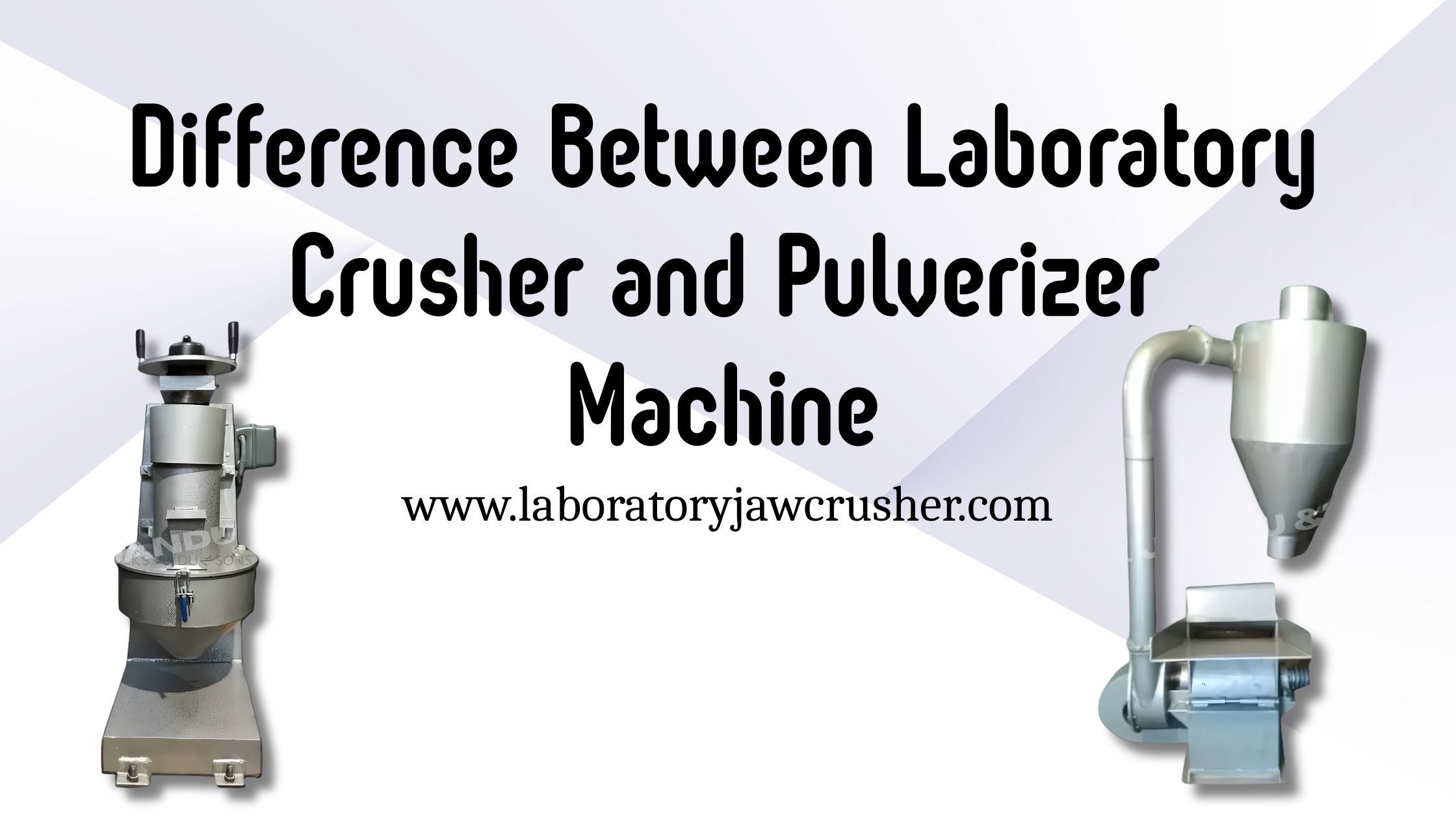
In the world of laboratory testing, research, and quality control, sample preparation is one of the most important steps for obtaining accurate and reliable results. Before a material can be analyzed for its physical, chemical, or mechanical properties, it must first be processed into a suitable form. This is where equipment such as the Laboratory Crusher and Laboratory Pulverizer Machine plays a critical role.
Many laboratory professionals often use the terms crusher and pulverizer interchangeably. However, these machines perform different functions and are designed for different stages of sample preparation. Understanding the difference between a Laboratory Crusher and a Laboratory Pulverizer Machine is essential for selecting the right equipment and ensuring accurate laboratory analysis.
As a trusted Laboratory Crusher Manufacturer and Laboratory Pulverizer Machine Manufacturer, K. S. Jandu & Sons provides high-performance sample preparation equipment designed to meet the requirements of mining laboratories, cement plants, research institutions, construction material testing facilities, and industrial quality control departments.
This comprehensive guide explores the differences, applications, advantages, and selection criteria for both machines.
Understanding the Sample Preparation Process
Before discussing the differences, it is important to understand how sample preparation works in laboratory environments.
Raw materials often arrive in large, uneven pieces that are unsuitable for laboratory testing. To achieve accurate analysis, these materials must be reduced to a uniform size.
The sample preparation process generally involves two stages:
Stage 1: Primary Size Reduction
Large material pieces are reduced into smaller fragments using a Laboratory Crusher.
Stage 2: Fine Grinding and Pulverization
The crushed material is further processed into fine powder using a Laboratory Pulverizer Machine.
Both machines work together as part of a complete sample preparation system, but their functions and capabilities differ significantly.
What is a Laboratory Crusher?
A Laboratory Crusher is a machine designed for the initial stage of sample preparation. Its primary purpose is to reduce large chunks of material into smaller, manageable pieces.
Laboratory crushers are commonly used to crush:
- Rocks
- Minerals
- Coal
- Limestone
- Cement clinker
- Ores
- Construction materials
- Metallurgical samples
The output from a laboratory crusher is typically coarse material rather than fine powder.
A high-quality Laboratory Crusher is designed to handle hard and abrasive materials while maintaining consistent crushing performance.
Types of Laboratory Crushers
Different laboratories require different crushing capabilities depending on the material being tested.
Laboratory Jaw Crusher
The Laboratory Jaw Crusher is one of the most commonly used crushers in testing laboratories.
It consists of two jaws—one fixed and one moving—that compress material between them.
Advantages
- High crushing efficiency
- Suitable for hard materials
- Durable construction
- Consistent output size
Applications
- Mining laboratories
- Cement plants
- Geological testing facilities
- Metallurgical laboratories
Laboratory Roll Crusher
A roll crusher uses rotating rollers to crush materials.
The material is fed between the rollers and compressed until it breaks into smaller pieces.
Advantages
- Uniform particle size
- Controlled crushing action
- Low dust generation
Applications
- Coal testing laboratories
- Mineral processing facilities
- Construction material testing
Laboratory Hammer Crusher
This crusher uses rotating hammers to break materials through impact force.
Advantages
- High throughput
- Efficient crushing of brittle materials
- Versatile operation
Applications
- Chemical industries
- Coal testing
- Construction materials
What is a Laboratory Pulverizer Machine?
A Laboratory Pulverizer Machine is used after the crushing stage to further reduce material size into fine powder. Unlike a crusher, which produces coarse particles, a pulverizer is designed to create highly uniform and homogeneous samples suitable for laboratory analysis.
Fine particle size is essential for many testing procedures because analytical instruments require consistent samples to generate accurate results.
A Laboratory Pulverizer Machine is commonly used for:
- Coal analysis
- Mineral testing
- Cement testing
- Chemical analysis
- Metallurgical studies
- Soil testing
- Research applications
The machine operates using grinding mechanisms that apply impact, friction, and attrition forces to reduce particle size.
A trusted Laboratory Pulverizer Machine Manufacturer ensures that the machine delivers uniform grinding results and long-term operational reliability.
How Does a Laboratory Pulverizer Machine Work?
The pulverization process begins after the material has already been reduced by a crusher.
The crushed sample is introduced into the grinding chamber of the pulverizer, where it undergoes further size reduction.
1. Impact Grinding
High-speed rotating components strike the material repeatedly, breaking it into finer particles.
2. Friction Grinding
Grinding surfaces rub against the material to gradually reduce particle size.
3. Attrition Grinding
Particle-to-particle interaction contributes to the production of fine powder.
The final output is a homogeneous sample that is suitable for chemical, physical, and mechanical testing.
Because of its precision, a Laboratory Pulverizer Machine is considered essential for laboratories that require highly accurate analytical results.
Major Differences Between Laboratory Crusher and Laboratory Pulverizer Machine
Although both machines are used for sample preparation, they serve completely different purposes.
1. Purpose
A Laboratory Crusher performs primary size reduction, while a Laboratory Pulverizer Machine performs fine grinding.
2. Input Material
Crushers handle large chunks of material, whereas pulverizers process already-crushed samples.
3. Output Size
Crushers produce coarse particles, while pulverizers produce fine powder.
4. Application Stage
Crushers are used at the beginning of sample preparation, while pulverizers are used at the final stage.
5. Testing Readiness
Crushed samples usually require further processing before analysis. Pulverized samples are generally ready for laboratory testing.
6. Precision
Pulverizers offer much greater particle size consistency than crushers.
In most laboratories, both machines work together to achieve accurate sample preparation.
Why Laboratories Need Both Equipment
Many laboratories cannot rely on only one machine because sample preparation often requires multiple stages.
For example, a mining laboratory may receive a large rock sample weighing several kilograms. The sample first passes through a Laboratory Crusher to reduce its size. The crushed material is then processed through a Laboratory Pulverizer Machine to create a fine powder suitable for chemical analysis.
This two-stage process ensures:
- Representative sampling
- Improved testing accuracy
- Better analytical consistency
- Faster laboratory workflows
Industries such as mining, cement, metallurgy, and construction frequently use both machines as part of their standard testing procedures.
Choosing the Right Laboratory Crusher Manufacturer
Selecting a reliable Laboratory Crusher Manufacturer is critical for ensuring performance and durability.
Factors to consider include:
- Manufacturing expertise
- Product quality
- Machine durability
- Technical support
- Spare parts availability
- Industry experience
A high-quality crusher can significantly improve laboratory efficiency and reduce maintenance costs.
Choosing the Right Laboratory Pulverizer Machine Manufacturer
When selecting a Laboratory Pulverizer Machine Manufacturer, laboratories should focus on:
- Grinding accuracy
- Particle size consistency
- Energy efficiency
- Ease of maintenance
- Build quality
- Customer support
Reliable pulverizer machines help laboratories achieve accurate and repeatable analytical results.
Why K. S. Jandu & Sons is a Trusted Name
As an experienced Laboratory Crusher Manufacturer and Laboratory Pulverizer Machine Manufacturer, K. S. Jandu & Sons has built a reputation for delivering durable and precision-engineered laboratory testing equipment.
1. Industry Experience
The company has extensive experience serving mining, cement, metallurgical, construction, and research laboratories.
2. Quality Manufacturing
Every machine is manufactured using premium materials and advanced engineering techniques.
3. Consistent Performance
The equipment is designed to provide accurate sample preparation and long-term reliability.
4. Customized Solutions
Machines can be tailored to specific testing and operational requirements.
5. Strong Customer Support
The company provides technical assistance, installation guidance, and after-sales service.
Conclusion
While a Laboratory Crusher and a Laboratory Pulverizer Machine may appear similar, they play very different roles in laboratory sample preparation. A crusher is responsible for primary size reduction, while a pulverizer produces the fine powder necessary for accurate laboratory analysis.
Understanding these differences helps laboratories select the right equipment and create efficient sample preparation workflows. For industries that depend on accurate testing and quality control, investing in equipment from a trusted Laboratory Crusher Manufacturer and Laboratory Pulverizer Machine Manufacturer is essential.
With decades of expertise and a commitment to quality, K. S. Jandu & Sons continues to provide reliable laboratory sample preparation equipment that supports accurate testing, research excellence, and industrial quality assurance.